
The ‘Belhuis’, a former vicarage
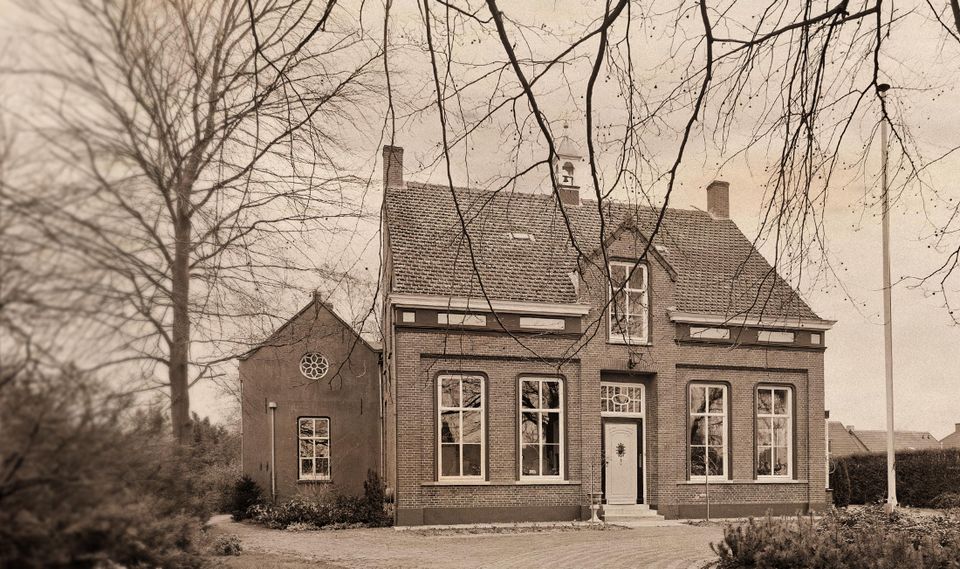
Everyone in Hapert knows het Belhuis; here is its story.
A vicarage belongs to a church. At the time this vicarage was founded,
the parish church stood on the Oude Provincialeweg near what is now number 69, then known as Kerkeind.
A path ran from this old church to the vicarage on Kerkstraat.
The current street names Kerkepad and Pastoriepad still refer to this old path.
This old church was demolished around 1858 and a new church was built on Kerkstraat. More
on this in a moment.
On the site where het Belhuis now stands, the vicarage had already stood prior to the introduction of the land registry on plots C 482, 483 and 484, owned by the Roman Catholic hamlet of Hapert.
A new vicarage was built just behind the existing building so that the vicar could continue to live there whilst the new one was being built.
The vicarage was completed in 1883.
The…
Everyone in Hapert knows het Belhuis; here is its story.
A vicarage belongs to a church. At the time this vicarage was founded,
the parish church stood on the Oude Provincialeweg near what is now number 69, then known as Kerkeind.
A path ran from this old church to the vicarage on Kerkstraat.
The current street names Kerkepad and Pastoriepad still refer to this old path.
This old church was demolished around 1858 and a new church was built on Kerkstraat. More
on this in a moment.
On the site where het Belhuis now stands, the vicarage had already stood prior to the introduction of the land registry on plots C 482, 483 and 484, owned by the Roman Catholic hamlet of Hapert.
A new vicarage was built just behind the existing building so that the vicar could continue to live there whilst the new one was being built.
The vicarage was completed in 1883.
The first vicar to live there was Father van Dongen; the last was Father van Gerwen, who became the architect of the new vicarage,
In 1926, a new vicarage was built next to the new Severinus Church, which had been built in 1923 at the start of Kerkstraat.
The old vicarage, ‘ het Belhuis’, was sold to Johannes Franciscus Hermans, a cigar manufacturer for the Hemazon brand and, later, also for Count Tilly.
Hermans was married to Maria Elizabeth Claassen , from the tramstation , and they lived in the house that is now known as ‘Poort van Brabant’.
He bought the vicarage, with its large garden, for 7,000 guilders.
The family moved from Kerkeind to Kerkstraat.
For the Hermans family, it served not only as their home but also as a shop selling colonial goods and manufactured goods. J.F. Hermans died in 1939; the shop closed a year later.
Residents of het Belhuis:
1883–1889: Father van Dongen
1889–1912: Father Vermeer
1912–1926: Father van Gerwen
1926–1929: The Hermans family; Grandad and Granny, a family of 14 children
1929–1968: Grandad and Granny Hermans with their son, daughter-in-law and grandchildren
1968–1994: The van de Wal family, former director and owner of the Belffires fireplaces factory.
1994–2017: The Lenders family;
2017–2025: The Gooskens family;
2025–present: The Krikken family
het Belhuis ’s residents were the parish priests of hapert – successively Father van Dongen, Vermeer and van Gerwen – the Hermans family, the van de Wal family (former director and owner of the Bellfires fireplace factory), the Lenders and Gooskens families, and now the Krikken family. Renovations and alterations have been carried out on the house
over the years, but het belhuis still retains its historic character.
Next to het Belhuis , you can now see the Roman Catholic cemetery.
Before the new (now no longer so new) parish church was built at the start of Kerkstraat, a predecessor stood on the site of the current cemetery from 1857 onwards, consecrated in 1858 by Auxiliary Bishop Deppen.
This church therefore did not exist for very long.
In 1930, shortly after the new church was completed, this old church was demolished.
It had to be replaced because it had become too small and was falling into disrepair.
Interestingly, the church built in 1858 was initially constructed without a tower.
In 1900, 58 hectares of marshland in Hapertsche Goor were sold to the Belgian Baron van Eethen.
This sale raised approximately 4,000 guilders. Of this sum, 1,
000 guilders were made available to the parish council in 1900 for the purpose of building a tower for the Roman Catholic church.
The remainder was used to construct approximately 600 metres of cobbled road from the provincial road to the state schools, that is, as far as ‘ het Pleintje’.
The tower was built and remained standing after the church was demolished, until it too was demolished in 1956.