
Hapert ’s Old Church
Kerkeind / Oude Provincialeweg
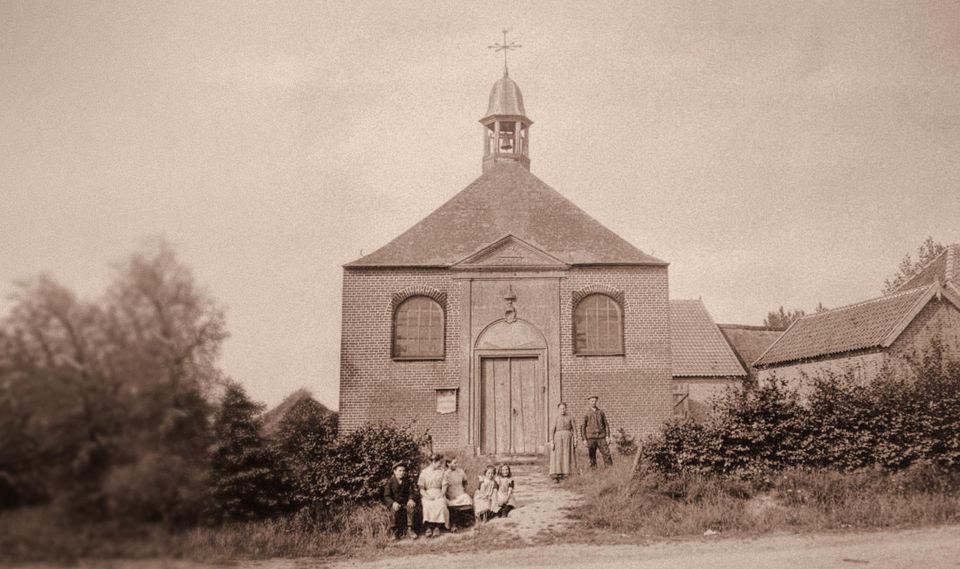
If we’d been standing here some 200 years ago, we would have seen the heart of Hapert as it was back then. There was
no MFA, but important buildings in Hapert did stand here.
The Roman Catholic church, and later a small Protestant church, were located here. Drawings from 1788 and 1830 give us an idea of what it once looked like.
The Catholic church was first mentioned as early as the early 17th century; in 1648, following the Peace of Münster, the church, like all churches in the area, fell into the hands of the Protestants. This lasted
until around 1800, when the Catholics regained possession of the church. In 1857, the church was demolished. The tower remained standing for some time, but was eventually demolished in the early 1900s.
We get an idea of what the church looked like from a drawing dating from 1788 by Hendrik Verhees, an architect and surveyor who drew many churches, including the church in Hapert.
On the…
Kerkeind / Oude Provincialeweg
If we’d been standing here some 200 years ago, we would have seen the heart of Hapert as it was back then. There was
no MFA, but important buildings in Hapert did stand here.
The Roman Catholic church, and later a small Protestant church, were located here. Drawings from 1788 and 1830 give us an idea of what it once looked like.
The Catholic church was first mentioned as early as the early 17th century; in 1648, following the Peace of Münster, the church, like all churches in the area, fell into the hands of the Protestants. This lasted
until around 1800, when the Catholics regained possession of the church. In 1857, the church was demolished. The tower remained standing for some time, but was eventually demolished in the early 1900s.
We get an idea of what the church looked like from a drawing dating from 1788 by Hendrik Verhees, an architect and surveyor who drew many churches, including the church in Hapert.
On the site where the church once stood, a monumental villa was built in 1935 by Master Arnoldus van de Put, designed by the architect Frans Kerkhofs from Reusel.
This house still stands today and is a listed building.
Next to what was then the Roman Catholic church stood a small school and the teacher’s house. This is where the children of Hapert were taught around 1800, not in a traditional classroom setting but through individual tuition. Not much is known about this. It is likely that the school ceased to function as such in 1865 and became a small house. The school moved to ‘ het Pleintje’. More on that in another section of the walk,
Protestant church
When the church was returned to the Catholics, the Protestant community in Hapert was left without a place of worship. Plans were drawn up for a new Protestant church. On the other side of the main road, then known as Kerkeind, construction of a Protestant church began in 1826. This little church was consecrated in 1828. As there were so few Protestants living in Hapert to maintain the church, it fell into disrepair and was demolished in 1954, despite its listed status. This little church stood to the right of the Poort van Brabant.
Of course, there was also a vicarage at the time. In the archives of the BHIC in Den Bosch, we found a deed dating from 1660.
The vicar at the time states in this document that the vicarage in Hapert had been severely damaged by a storm. He requested financial assistance to repair the damage. In his request, he describes how the damage included, amongst other things, the gate and the moat. If we look at the land registry drawings from 1828, we see that the only building in Hapert shown with a moat was situated at what is now Oude Provinciale Weg 56. This may well be the same property. Later, it became the home of the mayor and notary Meijer; Toon Tijssen, the milkman, was based there; and today it houses Hendriks’ off-licence. A new vicarage was built on Kerkstraat. More on this in another section of the walk.
There were a number of farms in the immediate vicinity.
We can also see the restaurant ‘De Poort van Brabant’ here. This building was constructed in 1858 and has served many different purposes over the years. It began as a smithy run by Hubertus Krijnen, who built the premises. It was later owned by the vet Hendriks, became Hotel de Meijerij run by Vervaet, and at one time served as a shop and cigar factory run by Hermans, a pub and even a butcher’s shop.
In 1660, the minister of Bladel and Hapert submitted a request for repairs to damage to the vicarage caused by a storm that raged in 1660. In his request, he described how the damage included, amongst other things, the gate with the moat. The cadastral map of Hapert shows one house with a moat, on the corner of Abdijstraat and the old Provincial Road. In 1832, this property belonged to Jan Meijer, a Dutch Reformed mayor and notary.
Perhaps this was the NH vicarage of Hapert back then?