
Tramstation station, Café de Zwaan and cycle storage
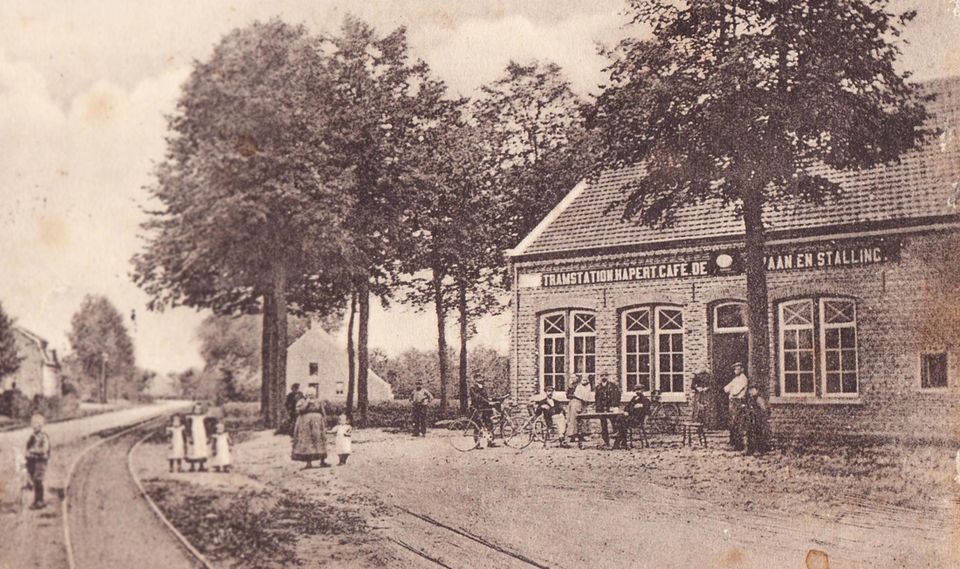
Between 1897 and 1935, a steam tram ran from Eindhoven to the border with Reusel .
This tram carried both passengers and goods. Tram stations were set up
along this route, often in existing premises.
These were frequently cafés that also served as tram stops.
There were two such tram stations in Hapert .
‘De Kuil’ was one station; ‘De Zwaan’ on what is now Oude Provincialeweg was the other.
The house in which the latter tramstation was located still stands today and is a listed building.
History of the old tramstation.
When the land registry was established in 1832, a house/farmstead with a yard, barn, garden and arable land already stood on this site.
It was owned by a certain Peter Dankaarts and was registered in the land registry under numbers C 609–610 and 611 (see fig. 1).
In 1835, the entire property passed to his son Jacobus Dankaarts following a division of the estate.
On 23 February 1…
Between 1897 and 1935, a steam tram ran from Eindhoven to the border with Reusel .
This tram carried both passengers and goods. Tram stations were set up
along this route, often in existing premises.
These were frequently cafés that also served as tram stops.
There were two such tram stations in Hapert .
‘De Kuil’ was one station; ‘De Zwaan’ on what is now Oude Provincialeweg was the other.
The house in which the latter tramstation was located still stands today and is a listed building.
History of the old tramstation.
When the land registry was established in 1832, a house/farmstead with a yard, barn, garden and arable land already stood on this site.
It was owned by a certain Peter Dankaarts and was registered in the land registry under numbers C 609–610 and 611 (see fig. 1).
In 1835, the entire property passed to his son Jacobus Dankaarts following a division of the estate.
On 23 February 1847, Cornelis Claassen purchased the farm, the house, the bakehouse, the barn, the garden, the yard and the agricultural land. In
total, it comprised three bunder and 48 roeden.
The purchase price was 1,600 guilders.
In the deed of sale, the farm is referred to as ‘Paddeklanken’.
In 1892, Cornelis Claassen passed away, and his only son, Peter Johannes, became the new owner by inheritance.
In that same year, the plots were merged into a new plot number, C2998.
The old farmhouse was demolished and a new one was built (fig. 2).
This is the farmhouse that still stands today, albeit without the side wing.
Cornelis was listed in the land registry as a farmer and innkeeper.
In 1904, a division took place.
C 2998 was split into C 3218 and C 3219. C 3219 is the plot of the farm on which the tram stop is now situated; a barn was added.
Also, (part of) the side wing was demolished. A new house was built on plot C 3218 (Fig. 3)
. With the exception of a brief period when it belonged to the beer brewer Kerkhofs from Reusel , the property has remained the property of and has been inhabited by the Claassen family to this day.
Stalling
Op het pand staat ook het woord ‘Stalling’.
Dit was vroeger een paardenstalling.
Er was een netwerk van postkoetsen dat een soort openbaar vervoernet vormde.
In Tramhalte, Café de Zwaan en Stalling konden paarden gewisseld, gevoerd en gestald worden.
Cornelis Claassen is also mentioned in the 1860s as the tenant in charge of the toll collected on the Eindhoven–Reusel road.