
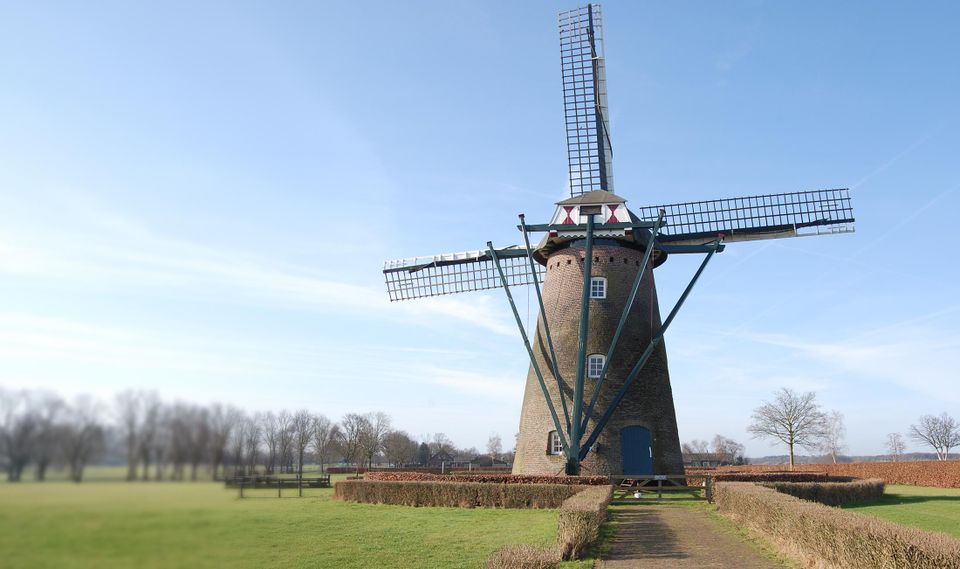
Mills were very important for many centuries; there was once a watermill in Hapert on the Grote Beerze. However,
it burnt down in 1859, and from that moment on, Hapert no longer had a mill.
The nearest mills were the Casterse Mill and the Teurlings Mill in Bladel.
A few decades later, however, a mill did return to Hapert.
We are now standing in front of this beautiful windmolen, the year of construction of which remained uncertain for a long time. The words ‘Anno 1896’ are inscribed in elegant letters
on the mill’s cap.
However, this date has long been called into question, and here we describe the mill’s origins according to official documents.
On 8 July 1898, Franciscus Sanders applied to the municipality of Hoogeloon for permission to establish a corn mill in Hapert. On 24 September 1898,
he purchased a small plot of pasture (C170a) from the Bans family for 200 guilders and a small plot of arable land for 70 guilders (C202).
On…
Mills were very important for many centuries; there was once a watermill in Hapert on the Grote Beerze. However,
it burnt down in 1859, and from that moment on, Hapert no longer had a mill.
The nearest mills were the Casterse Mill and the Teurlings Mill in Bladel.
A few decades later, however, a mill did return to Hapert.
We are now standing in front of this beautiful windmolen, the year of construction of which remained uncertain for a long time. The words ‘Anno 1896’ are inscribed in elegant letters
on the mill’s cap.
However, this date has long been called into question, and here we describe the mill’s origins according to official documents.
On 8 July 1898, Franciscus Sanders applied to the municipality of Hoogeloon for permission to build a corn mill in Hapert. On 24 September 1898,
he purchased a small plot of pasture land (C170a) from the Bans family for 200 guilders and a small plot of arable land for 70 guilders (C202).
It was on this latter plot of land that the mill was to be built. A
striking feature of the deed of sale is the clause stipulating that any buildings erected on the site must not house an inn, a beer hall or any related business.
Deed drawn up by Notary Hordijk in Vessem,
On 1 August 1898, Sanders and his small family were registered as residents of Hapert, having moved from Meijel to live with the Bans family.
It appears that he had already begun building the mill before the land was officially his.
A provincial report lists him, as of 1 January 1899, as the owner of a grain mill in the municipality of Hoogeloon , including its annexes.
That is a very short construction period if he bought the land in September 1898.
Especially when you consider that parts were sourced from elsewhere.
This was very common in Brabant in the late 19th century.
In old photographs of the mill, taken before its restoration in 1972, there is no year indicated on the mill’s cap!
Nor is there any year visible in photographs of the restoration in 1989. It is therefore unclear
where the year comes from.
‘Anno 1896’ is, in reality, ‘Anno 1898’.
On 4 December 1901, Frans Sander sold his properties in Hapert: plot
170a for 250 guilders and the plot on which the mill had since been built for 4,650 guilders.
Shortly afterwards, the family set off for Achel in Belgium.
Frans Sanders built another windmolen in Hamont-Lo.
This no longer exists. The Hapert mill was sold to Johannes Adrianus Franciscus Willems, a miller originally from Diessen.
He had married Willebrordina Damen there shortly before.
Willems bought a house for 850 guilders, along with a small plot of land, which had been built quite recently on a plot adjoining the mill.
Here, the couple had four children, one of whom died at a young age.
In 1924, Willems applied for a licence to build a machine room for a milling operation. From then on, therefore, milling was no longer carried
out solely by wind power.
A fire broke out in the miller’s house in 1928, and it had to be rebuilt.
It was then given a different design to the original house. Whilst the house before the fire was
farmhouse-style, the rebuilt building was more like a warehouse.
In 1942, Johannes Willems passed away and the mill became the property of his widow, Willebrordina Damen.
Willem Verhees from Netersel then became the new miller.
This Willem Verhees married Agnes, the daughter of Johannes Willems, and, following a division of the estate, took over the mill on 1 April 1953. It is doubtful
whether the mill was still being operated by wind power at that time.
In 1970, the mill, which had by then fallen into disrepair, was purchased for 5,000 guilders by the then municipality of Hoogeloon. Restoration work followed
in 1972–73, carried out by the Groningen-based mill-building firm Roemeling & Molema.
It was evident that a millwright from Groningen had travelled to the south of Brabant for the restoration: sails manufactured by Buurma (Oudeschans) have remained extremely rare south of the rivers, and the sail cap was also given a typical Groningen colour scheme: white with red accents.
In 1989, the exterior of the mill was refurbished.
Immediately following this restoration in 1972, Lieuwe Tilma, a volunteer miller from the very beginning, approached the council with a request to be allowed to run the mill regularly.
Tilma’s role as miller proved to be a success.
After more than 30 years, in 2004, he handed over his role to Jos Jansen. He received an award from the municipality of Bladel
in recognition of his many years of service.
Lieuwe Tilma passed away on 16 December 2007.
In 2020, the mill was in need of a major restoration: the sail cross was completely replaced and the tail was largely renewed.
Furthermore, the Van Bussel sail system was reinstalled in the mill to maximise the efficiency of the wind power.
The system had been removed in 1972.
The mill has been a listed building since 1967.
The mill is still in operation today and is run by two millers.
Jos Jansen is still a miller, alongside Ben van Roosmalen.
Ab Schrader is a trainee miller at the Hapert mill, so the mill’s future seems secure for the time being.
The mill is open to visitors on the first and third Saturday of every month.