
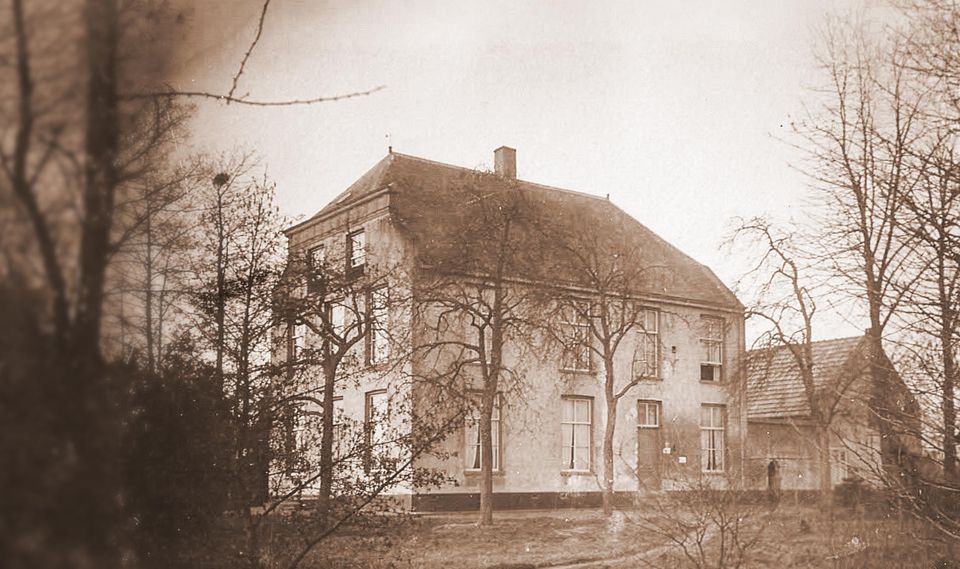
150 years ago, there stood a genuine mansion in Hapert, known to the people of Hapert as ‘Kasteeltje’.
On 14 July 1854, Johannes Josephus Hubertus van Schenck van Nijdeggen, a priest living in Den Bosch, purchased several plots of land (C493 to 496) from Elisabeth Cornelissen.
He was the son of a noble family and set about building his new home here.
The sale was concluded in the vicarage, with Father Lambert de Jongh and curate Antonius Waght acting as witnesses.
On this plot of land, on the street now known as Nieuwstraat, stood a house with an annexe.
The contract of sale stipulated that the house would be demolished and the rubble removed by the seller.
He was registered in the population register in Hapert on 1 May 1855, with his occupation listed as Roman Catholic priest. Prior to that,
he had been a curate in Driel and an assistant priest in Heusden.
The story …
150 years ago, there stood a genuine mansion in Hapert, known to the people of Hapert as ‘Kasteeltje’.
On 14 July 1854, Johannes Josephus Hubertus van Schenck van Nijdeggen, a priest living in Den Bosch, purchased several plots of land (C493 to 496) from Elisabeth Cornelissen.
He was the son of a noble family and set about building his new home here.
The sale was concluded in the vicarage, with Father Lambert de Jongh and curate Antonius Waght acting as witnesses.
On this plot of land, on the street now known as Nieuwstraat, stood a house with an annexe.
The contract of sale stipulated that the house would be demolished and the rubble removed by the seller.
He was registered in the population register in Hapert on 1 May 1855, with his occupation listed as Roman Catholic priest. Prior to that,
he had been a curate in Driel and an assistant priest in Heusden.
The story goes that he was disappointed not to have been appointed parish priest in either Driel or Heusden and therefore withdrew.
His mother also came to live with him in his new house in Hapert .
At the time of his death (29 August 1865), he owned three houses and plots of land in Hapert; he also held property in Gelderland, notably in Beuningen, Winssen, Ewijk and Overasselt.
His estate was worth over 60,000 guilders.
By way of comparison: an annual wage in North Brabant at that time was around 250 guilders.
After his death, the properties in Hapert passed to Napoleon Sassen, a friend of van Schenck van Nijdeggen.
Sassen is recorded as a prominent lawyer in ‘s-Hertogenbosch.
He was a municipal councillor, a member of the Provincial Council and a member of the Senate of the States General.
In 1869, Sassen laid out the castle avenue, running from the Kuil to the mansion.
Sassen did not live there himself, but the little castle served as a temporary residence for Mayor Adrianus van Eyk, and Mayor Hoeks also lived there temporarily.
The little castle remained in the family until 1912.
In August of that year, the Sassen family held a public auction.
In the description, it was referred to as ‘Huize Rustoord’.
The little castle was sold to the Delhaye family, confectioners from Tilburg.
The family actually moved in to live there (according to the Tilburg Municipal Register).
In 1920, the mansion was put up for sale on behalf of the Delhaye family via a public auction. The advertisement described the property
as suitable for use as a hotel, a guesthouse, a convent or for various other purposes.
Henri Antoine van de Water, a cigar manufacturer from Bladel,
acted on the suggestion that the property would be suitable as a guesthouse almost immediately. In 1921,
he established the guesthouse ‘het Haperts Kasteeltje’
there. He did not enjoy it for long, however, as Henri Antoine died on 15 October 1923.
His widow became the owner. In 1929, she moved to Eindhoven.
Later, part of the land was sold off and Pieter van de Water set up a cigar factory there, on the site of what is now number 22 Nieuwstraat.
In 1939, Pieter J J van de Water sold the property to Petrus van Hoof.
A daughter of Petrus van Hoof married ‘Mister’ Johannes Joseph (Jan) Mariën in 1940; they were the last residents of the Kasteeltje, which was demolished in 1961.
The names Kasteellaan and Park Kasteelrode serve as a reminder of the little castle