
Reformed regional school in Hapert: ‘De Kuil’
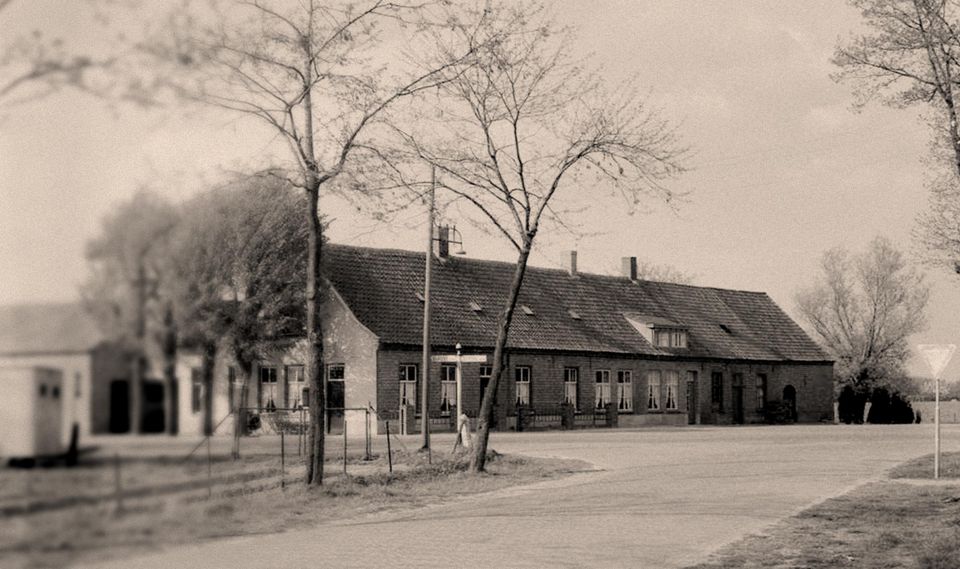
Until the early 20th century, the various villages around Hapert had almost exclusively state schools.
In Casteren and Hoogeloon there were mixed schools, whilst Hapert had a boys’ school and a girls’ school.
In 1920, the Primary Education Act was introduced. This meant that special schools (i.e. Catholic or Protestant schools) were placed on an equal financial footing with state schools by the government. As a
result, many state schools were converted into Catholic schools. The number of Protestant pupils was very small – too small to establish a Protestant school in every village.
The (few) Protestant pupils had to attend Catholic schools.
Naturally, this was not well received, and in 1936 a public regional school was built here on the corner of Weijer and Nieuwstraat. It was agreed
with the surrounding villages that the Protestant pupils from the municipalities of Bladel , Netersel, Eersel, Hoogeloon, Hapert and Casteren would attend this regional school.
In 1940…
Until the early 20th century, the various villages around Hapert had almost exclusively state schools.
In Casteren and Hoogeloon there were mixed schools, whilst Hapert had a boys’ school and a girls’ school.
In 1920, the Primary Education Act was introduced. This meant that special schools (i.e. Catholic or Protestant schools) were placed on an equal financial footing with state schools by the government. As a
result, many state schools were converted into Catholic schools. The number of Protestant pupils was very small – too small to establish a Protestant school in every village.
The (few) Protestant pupils had to attend Catholic schools.
Naturally, this was not well received, and in 1936 a public regional school was built here on the corner of Weijer and Nieuwstraat. It was agreed
with the surrounding villages that the Protestant pupils from the municipalities of Bladel , Netersel, Eersel, Hoogeloon, Hapert and Casteren would attend this regional school.
In 1940, the state school became a Reformed school.
Pupil numbers were low in the early years; for a time, it was a one-teacher school.
However, in the 1970s, these numbers rose. The Raepeweijer neighbourhood was built, as were
Het pand werd zelfs te klein en in 1976 verhuisde de school Marnix van St. Aldegonde naar de voormalige VGLO school.
De oude Hervormde Streekschool kwam leeg te staan.
Een koper werd niet gevonden en het pand werd begin jaren 80 afgebroken om plaats te maken voor woningen.
De Kuil
In 1895 kocht Robert Poppeliers een stuk weiland (HYP4 473-41) en bouwde er een woonhuis Poppeliers was metselaar.
Hij begon er een herberg die regelmatig locatie was voor openbare verkopen. (Advertenties Delpher 1898 – 1902 etc).
Hier werd bijvoorbeeld de openbare verkoop van het kasteeltje gehouden. (1912).
Oorspronkelijk 1 huis (C2904); in 1900 aanbouw kleinere woning aan noordkant. Wordt dan C 3137 de Kuil, C 3138 aanbouwwoning.
In 1916 verkocht Poppeliers de Kuil aan Jan Francis Hermans, zijn zwager.
Deze verkocht in 1919 op zijn beurt het pand aan Gerardus Reijrink, koopman en bakker (hyp 4 735-150) uit Rekkem (Eibergen) maar deze vertrekt in 21-06-1920 naar Diessen.
Op 24 februari 1920 verkocht Reijrink de herberg met inboedel aan Arnoldus Maandonks. Koopman in paarden, bouwmaterialen enzovoort.
In 950-1951 bouwde Nolleke Maandonks, zoals iedereen hem kende, een bioscoopzaal en films als Goldfinger en Spartacus werden er vertoond.
1950 -1951 bouwde Maadonks een biosoopzaal (VW C 278)
In 1962 / 63 werd naast de cinema de dancing gebouwd.
De Kuil werd uitgaanscentrum van
Beroemde artiesten traden op zoals Adamo, Q65, ZZ en de Maskers.
Een hoogtepunt was zeker het optreden van Dave Berry, in die tijd zeer populaire Engelse zanger.
Tot de klad er in kwam. In de bioscoop en dancing werden later een levensmiddelenzaak, tapijthandel gevestigd.
Totdat het geheel werd afgebroken en er nieuwe woningen werden gebouwd.
The ‘De Kuil’ tram
stop also served as a stop on the Eindhoven–Reusel line.
This tram line opened in 1897 and was intended for both passenger and freight transport.
For farmers, it was an important supply route for fertiliser, seeds and seed potatoes. It
also made it easier to transport agricultural produce o naar buiten side the region.
Opposite De Kuil, two NCB warehouses were built for the storage of fertiliser, seeds, straw and similar goods.
The line was closed to passenger services in 1935, and freight services also came to an end in 1937.
There are still quite a few reminders of the steam tram to be seen along the former route of the line.